
As the Tom Holland summer Odyssey comes to an end, the box office enters a Brand New Day, five films crossed the at least $10M this weekend at the domestic box office, including three news releases, a strong second week holdover, and a re-release. Among the new releases, Paramount’s Heart of the Beast and A24’s Primetime fought for third place behind a re-release of Avengers: Endgame and the second weekend of Zach Cregger’s Resident Evil..
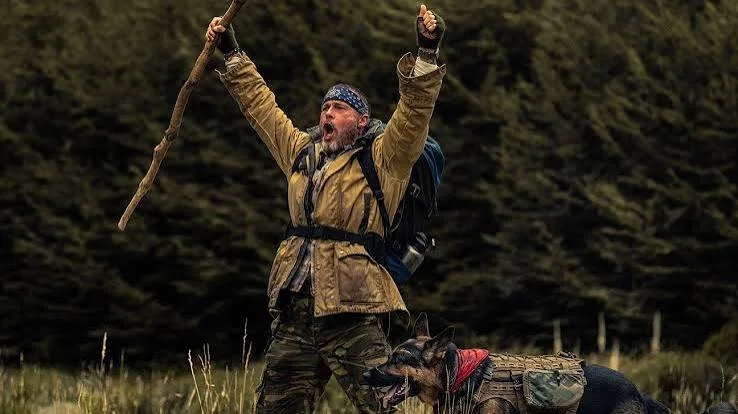
Heart of the Beast (Photo credit: Paramount Skydance).
It seems, at least until the actuals come out tomorrow, that the dog audience just outweighed the To Catch a Predator fanbase, with Heart of the Beast making an approximated $20M and Primetime making a little over $19M. However, the Brad Pitt and Odin vehicle cost ~$75M to make than the Chris Hansen biopic, giving it a far more difficult path off the opening to profitability. The good news for Paramount, though, is that while Pitt’s reputation as a box office draw has been heavily scrutinized this decade thanks in part to historically bad bombs such as Babylon, which while we at the DSR BOR adore the movie was realistically a tad too artsy for general audiences to begin with, and movies that likely did turn a profit like Bullet Train not nearly being as big of a hit as many expected it to be. Between that and the Angelina Jolie controversies, there’s a slight underestimation of the pull Pitt still brings, and with how much the dog movies haven’t been making at the box office, this is a premiere example of a movie with Brad Pitt that likely would’ve made significantly less than if Pitt hadn’t been in it.
Heart of the Beast still has a ways to go until profitability, but its A- CinemaScore and 87% Critic/93% audience scores on Rotten Tomatoes show high audience enthusiasm and perhaps encouraging word-of-mouth for a survival thriller that may not reinvent the wheel, but does a lot of things extremely well. The biggest number for Paramount is that the film drew over $30M this weekend internationally, and if the international legs can remain strong, then it should at least do a reliable number, even if it falls short of the estimated $205M it’ll need to be profitable. Pitt clearly still has a lot of pull internationally, as F1: The Movie made more than twice overseas as it did Stateside, and this film specifically opened huge in France, which is one of the few markets Babylon did extraordinarily well in. With the Cliff Booth spinoff becoming Netflix’s first proper IMAX release and The Riders on its way, it seems like F1 has pulled Brad Pitt out of the proverbial actors jail that Babylon locked him in.

Primetime. (Photo credit: A24)
Primetime, which performed just as well in domestically, and should realistically already be a profitable venture for A24. Sure, it’s an independent film that shows the atrocities of the people Chris Hansen hunts while also doing a character study on the power dynamics that muddied Hansen’s own morality while he hunts pedophiles. That’s not, on paper, going to generate blockbuster level interest. We also haven’t seen it perform in a number of global markets, making tracking its worldwide interest near impossible to this point. But with a $20M or so opening, which is already more than its budget, and the high totals A24 has been selling international rights for, this is an easy win for the studio, and its first time narrative feature director Lance Oppenheim. The big winner of 2026, as much as we discuss Tom Holland and Zendaya, is their Odyssey co-star. Pattinson became the talk of the town from his line reads in The Odyssey, which is still making around $4M domestically after 75 days in release. With a $1.7B box office to this point for The Odyssey, the record for highest-grossing R-rated film of all-time, and now two proper A24 hits this year on an old school mid-size budget, if Dune: Part Three can threaten a billion, then not only has his stock completely recovered from the underperformance of Mickey 17, Pattinson’s is on the precipice of becoming a proper, short list most-bankable movie star nearly 20 years after Twilight made him one of the Hollywood’s most polarizing leading men with a reputation he couldn’t shake until landing The Batman.
Can Dune: Part Three make $1B, though? That seems to be what quite a few tea leaves are reading, and I’m not personally sure. Timothee Chalamet is unequivocally the biggest movie star of his generation, and probably the world right now, and he’s only grown in star power. Dune: Part 2 made over $700M, an increase from its predecessor’s box office of over $300M. With a similar jump, it clears $1B with ease. The problem is that the release of the 2021 Dune flick makes it impossible to gauge how much the franchise has actually grown because audiences didn’t start truly returning to theatres from the pandemic until December’s Spider-Man: No Way Home, and Dune had been one of the films that Warner Bros gave its same-day HBO streaming release, ultimately crippling its box office. Was the first Dune always going to perform better than it actually did because of the pandemic? Has the franchise really grown in any meaningful way? Is an already inaccessible, hard sci-fi film capped at a certain box office before you even factor in that the third in the trilogy is based on Dune: Messiah, a widely divisive novel even amongst its die hard fans? Does a ‘Dunesday’ trend actually help when it isn’t organic in the same way as a Barbenheimer, and targets the same general demographics and the MCU seems to be hot again? The film looks like an absolutely remarkable feat as Denis Villeneuve seems to have once again proven he’s one of the best ‘spectacle’ filmmakers of all-time, but that doesn’t mean the box office is jumping $300M. That’ll be a conversation to have in a few months, though. The movie will absolutely do a very strong total and be a guaranteed hit for WB regardless.
The other new film that made at least $10M was Forgotten Island, which apparently families forgot to go see. This may end up being a sneaky hit with legs because its audience scores are absolutely terrific, showing that people who saw it did like it, but it opened extremely low, worrisomingly low. Maybe it can be the next Element which had a disastrous opening despite great reviews and ended up legging out to $500M. Family films, especially based on original IP, don’t always open strong but tend to leg into profits. However, it’s clear that Dreamworks didn’t exactly know how to market this film toward the family audience. Having not seen it yet myself, I struggle to give ideas how I would have marketed the film, but we’ll explore that next week, but at $80M, who knows if it’ll be able to multiple its worldwide opening weekend gross by a multiple of 10 to make a profit. It’s highly unlikely, and at this point, Universal should just hope it at least recoups its budget. Universal was the first studio of the year to $5B at the box office, on the strength of The Odyssey making nearly $2B, Michael being a massive international hit, and The Super Mario Galaxy Movie making over $1B. One proper bomb shouldn’t be all that detrimental to the studio.
Finishing at the top two, though, aren’t newcomers. Avengers: Endgame The Encore made $26M in its re-release. This brings its worldwide gross to $2.89B, just $40M shy of the original Avatar for the highest-grossing box office of all-time. There’s not much new to say about Avengers: Endgame, though its massive total this weekend does show enormous hype heading into Avengers: Doomsday.
Resident Evil saw a 60% drop, which is farily standard for horror. With its solid word-of-mouth, perhaps one could have hoped for a little bit of a lesser drop, but it’s firmly into profitable territory for Sony. You can see us discuss the film and its performance in detail in the report from last week.
The remaining top ten this week:
Practical Magic 2, $5.7M.
Spider-Man: Brand New Day, $4.1M.
The Odyssey, $3.7M.
Coyote vs. Acme, $1.9M.
Daniel and the Fiery Furnace, $1.5M.
Looking ahead, Digger is going to bomb next week, and that’s coming off the underperformance of back-to-back Mission Impossible movies. The question is going to be ‘how much interest is there still in Tom Cruise?’
Our argument for movie star isn’t that every movie you make is going to hit. At his peak from 1982 when Rocky III and First Blood came out, Sylvester Stallone had only two theatrical hits that weren’t franchised until 1993’s Cliffhanger and Demolition Man. Not only were his movies failing to make money theatrically, films like Rhinestone, Lock Up and Over the Top were failing to even make their budget back. Outside of the names Rambo and Rocky, Stallone couldn’t buy a hit for his peak ten years. Coming off Fresh Prince, Will Smith made Bad Boys, Independence Day, Men in Black, and Enemy of the State…then he made Wild, Wild West and The Legend of Bagger Vance. Following Big, the legendary Tom Hanks run is preceded by Punchline, Joe versus the Volcano, and The Bonfires of the Vanities. In an era where we judge the level of stardom somebody has on a film-by-film basis rather than overall track record, the argument shouldn’t be that every movie somebody does should force a reaction to their star power, which is what it has become. Every movie star at their peak has a number of movies that lose money. The argument should be whether or not the movies these actors make would make more money or less money without them, as that’s the mark of whether or not you can get somebody into theatres. We were just discussing this kind of thing with Brad Pitt struggling to get leading projects for a few years after Babylon and F1 immediately put him back in the conversation. Digger is not going to make a profit, but could it be a One Battle After Another scenario where it makes more than it has any right making on paper because of how big its lead star is? That’s going to be what we have to determine next week.
But there’s also Verity, as the year of Anne Hathaway continues. We’ll touch more on this next week, but with how big that book is in the booktok demographic and how strong the female audience has been this year, expect this to be a massive hit for MGM.
Jameus Mooney is an entertainment writer for Comicbook Clique, having covered the entertainment industry for years. You can follow him on Twitter here, and Letterboxd here. You can also listen to his horror podcast, The 2:17 Horror Podcast, at the DeathArts XIII YouTube channel.